The Byron Blog consists of writings, photographs, and
anecdotes related to my father, Byron Dobell (1927-2017)
In the course of things, I met and marveled at
movie stars, world leaders, tycoons, scientists, scholars, athletes, poets, and
assorted wise men and women, and lunatics. I’ve never spent much time thinking
about famous people I’ve known – it was, after all, the nature of the business
– but, to misquote Tennyson’s Ulysses, “All that I have met are
part of me” – and it was great fun.
–– from Byron’s speech when he was inducted into the American Society
of Magazine Editors Hall of Fame in April 1998
 |
| Clark Gable and Sophia Loren, in a scene from It Started in Naples (Photo: B. Dobell) |
In 1959, recently married to my mother Ande — and
no baby (me) yet, Byron takes Ande along on two assignments for This Week magazine, where he is now photo
editor:
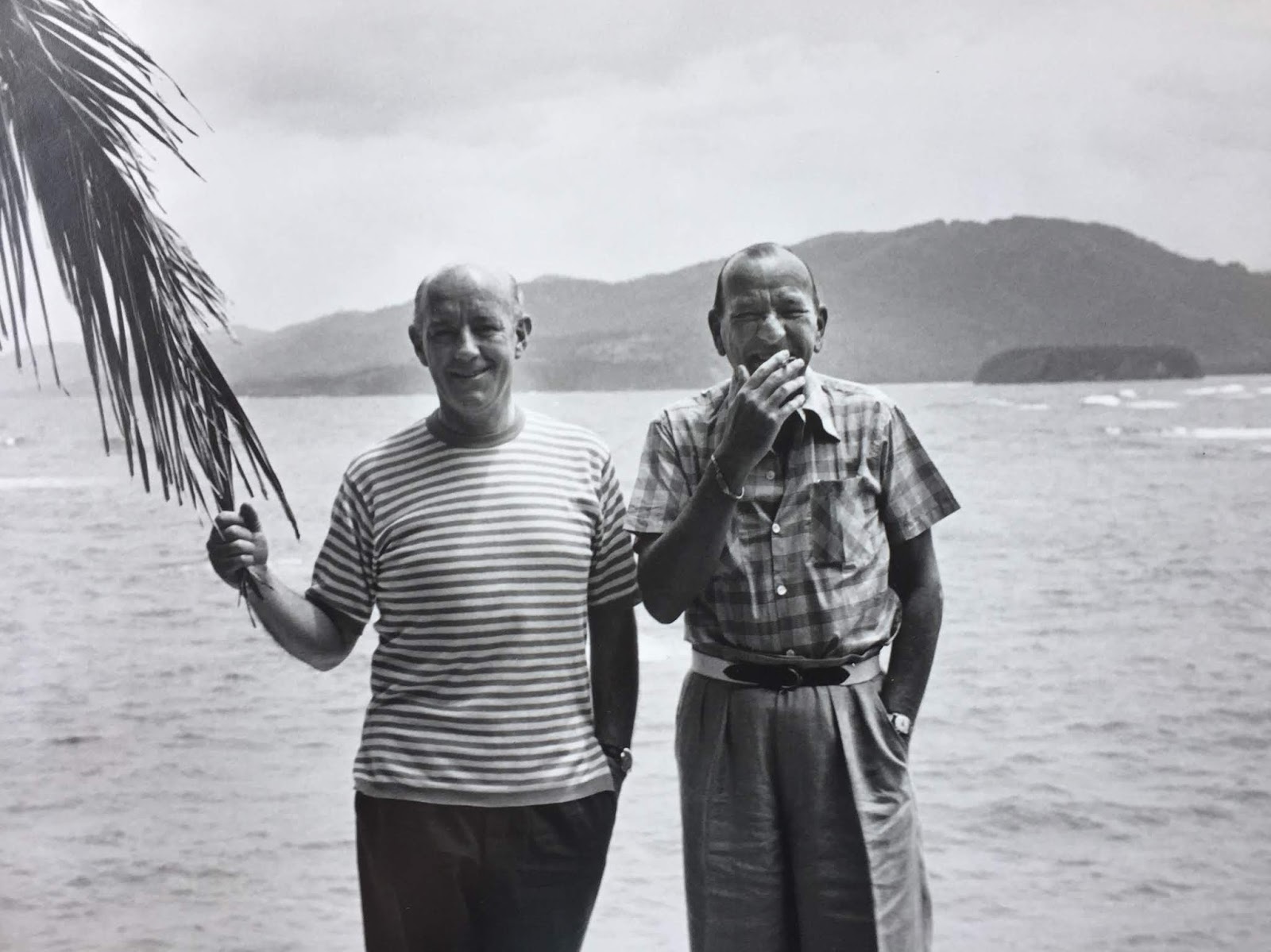
in April to Jamaica, to photograph Noel Coward
and Alec Guinness, who are taking a break from filming Our Man in Havana in Cuba, and are staying at Coward’s home, Blue
Harbour, in Port Maria, Jamaica;
in September to southern Italy, to photograph
Sophia Loren and Clark Gable, who are filming It Started in Naples, and also to photograph the cast of Five Branded Women (including actresses Barbara
Bel Geddes and Silvana Mangano, and director Martin Ritt).
Below are some of Byron’s photos from these assignments
(with a bit of my own Wikipedia-heavy annotation).
This Week was a nationally syndicated Sunday magazine supplement
that was included in American newspapers between 1935 and 1969. In the early
1950s, it accompanied 37 Sunday newspapers. https://en.wikipedia.org/wiki/This_Week_(magazine)
Here’s a cover of This
Week:
 |
This Week, Sunday, October 11, 1959
|
JAMAICA
Released December 1959
Our
Man in Havana is
a 1959 British spy comedy film, directed and produced by Carol Reed and starring Alec Guiness, Burl Ives, Maureen O'Hara, Ralph Richardson, Noel Coward and Ernie Kovacs. The film is adapted from the
1958 novel Our Man in Havana by Graham Greene. https://en.wikipedia.org/wiki/Our_Man_in_Havana_(film)
Noel Coward (1899-1973) was an English playwright,
composer, director, actor and singer. Coward's stage and film acting and directing
career spanned six decades, during which he starred in many of his own works. His plays include Private Lives, Present Laughter, and Blithe Spirit. https://en.wikipedia.org/wiki/Noël_Coward
Alec
Guinness (1914-2000) was an
English actor, known for such films as: The Ladykillers (1955), Kind Hearts and Coronets
(1949), and The Bridge on the River Kwai (1957), for which he won the Academy Award for Best Actor.
https://en.wikipedia.org/wiki/Alec_Guinness
At the time of Byron and Ande’s visit, Jamaica
was not yet independent from the United Kingdom. In 1958, it had become a
province in the West Indies Federation, a
political union of several Caribbean colonies of the United Kingdom. In 1962, Jamaica
left the federation and became an independent country.
https://en.wikipedia.org/wiki/Jamaica
Byron and Ande even made the front page of the Jamaican
newspaper The Daily Gleaner, which proudly
reported the publicity surrounding the Guinness visit in an article headlined “Coward,
Guinness stay boosts island” --
Saturday, April 11, 1959
Presence in Jamaica of Sir Alec Guinness, famed British
actor and Academy Award winner, has earned additional publicity for the island.
With his cooperation, and that of his host in Jamaica, Mr. Noel Coward, a photo
spread will appear shortly in This Week magazine,
a mass-circulation Sunday supplement which is carried by several leading
newspapers in the United States.
Mr. Byron Dobell, photo editor of the magazine, came to
Jamaica last weekend
to do the assignment. He took photographs of Sir Alec and
Lady Guinness and other houseguests of Mr. Coward at Mr. Coward’s home, “Blue
Harbour,” near Port Maria.
Among other celebrities staying with Mr. Coward at
present are Anton Dolin, the world-renowned ballet dancer; Graham Payn,
Broadway actor; and John Gilpin, brilliant young English dancer.
Mr. Dobell did a number of “shots” of the party during a
photographic session at noon on Sunday. He was given full cooperation by his
“subjects” and expressed himself as “extremely satisfied” with the success of
the assignment.
This island magazine publicity was organised by the
Jamaican Tourist Board through its New York publicity representatives, Ruder
& Finn. Mr. Dobell and wife arrived on the island on Saturday night and
left on Tuesday for New York.
While here, they stayed at Tower Isle Hotel and Casa
Montego.
This Week is a syndicated publication and the largest circulated magazine of
this type in the United States.
https://newspaperarchive.com/kingston-gleaner-apr-11-1959-p-17/
Alec Guinness and Noel Coward (Photo: B. Dobell)
|
 |
| Alec Guinness and Noel Coward (Photo: B. Dobell) |
 |
| Noel Coward (Photo: B. Dobell) |
 |
Alec Guinness (Photo: B. Dobell)
And, on one of Byron’s contact sheets, I found a shot of my mother and Coward.
|
 |
| Ande Dobell and Noel Coward (Photo: B. Dobell) |
ITALY
 It Started in Naples
Released August 1960
It Started in Naples is
an American romantic comedy film made by Paramount Pictures and released in August 1960. The film stars Clark Gable, Sophia Loren, Vittorio de Sica, and
an Italian cast.
Sophia Loren (b. 1933) is
an Italian film
actress. Loren began her film career in 1950 at age 16. She appeared in several
bit parts and minor roles in the early part of the decade, until her
five-picture contract with Paramount in
1956 launched her international career. https://en.wikipedia.org/wiki/Sophia_Loren
Clark Gable (1901–1960) was an American film actor, often
referred to as "The King of Hollywood". Between the years 1930 and
1960, he became a leading man in more than
60 motion pictures. It Started in Naples was
the final film to be released within Gable's lifetime and his last color film. https://en.wikipedia.org/wiki/Clark_Gable
 |
Clark Gable (photo: B. Dobell)
|
 |
| Sophia Loren (Photo: B. Dobell) |
 |
| Sofia Loren (Photo: B. Dobell) |
Released March 15, 1960
Five Branded Women is a 1960
Italian American film directed by Martin Ritt and produced by Dino de Laurentiis. It featured an
international cast, including Silvana Mangano, Barbara Bel Geddes, Jeanne Moreau, and Vera Miles, and was Ritt's only war movie, set during
the Nazi occupation of Yugoslavia.
“Yugoslav
partisans grimly crop the hair of a village quintet of women believed to have
consorted with the occupational Nazis. Four, for various reasons, have indeed -
and their seducer is a lone, swaggering sergeant whom the partisans briskly
emasculate. Escorted out of town by the sheepish Nazis, the forlorn ladies link
up, patriotically and romantically, with a band of tough mountain guerrillas.”
https://en.wikipedia.org/wiki/Five_Branded_Women
 |
Barbara Bel Geddes, knitting during a break on the set (Photo: B. Dobell)
Barbara Bel Geddes (1922
–2005) was an American stage, screen, and television actress. Her notable films
include I Remember Mama (1948)
and Vertigo (1958).
https://en.wikipedia.org/wiki/Barbara_Bel_Geddes
|
 |
| Silvana Mangano (Photo: B. Dobell) |
Silvana Mangano (1930 –1989) was an Italian
actress. She was married
to film producer Dino de Laurentiis from
1949 to 1988. Some notable films include Bitter
Rice (1949) and Death in Venice (1971).
 |
| Martin Ritt, Director (Photo: B. Dobell) |
Martin Ritt (1914-1990) was an American television and film
director. He was blacklisted by the TV industry during the early 1950s and
began directing movies some years later. Among other films, he directed: Edge of the City (1957), Hud (1963), The Spy Who Came In From The Cold (1965), Sounder (1972), The Front
(1976), and Norma Rae (1979).
Last, but not least .
. .
Another photographer on the set of It Started in Naples, John G. Ross, took the photo below (my
father is standing at top center, with camera; Gable is sitting at middle right):
 |
Photo: John G. Ross |
Ross gave Byron a print of the original image, as well as a
diagonal slice – capturing Byron’s proximity to the star!
 |
| Photo and crop: John G. Ross |
THE END